By the crew at Universal Truck & Trailer Repair, an independent, family-owned truck and trailer shop in West Chester Township, OH. ASE-certified diesel mechanics. Updated November 2026.
Every owner-operator has a maintenance budget, whether they set one or not. If you didn’t pick the number yourself, the truck picks it for you, usually in a year when a clutch and a set of drive tires come due within a few months of each other. Money you’ve been putting aside every week turns that into a rough stretch. Without it, a year like that can end with the truck parked.
Below are the latest cost numbers, the reasons most owner-operators should budget above the national averages, and a way to work out a per-mile figure for your own truck. Since our shop sits a few minutes off I-75 in West Chester Township, we also cover what Southwest Ohio weather and roads add to the bill.
The short answer
For a truck that’s out of warranty, set aside 25 to 40 cents for every mile you run, tires included. A newer truck still under warranty can start at 15 to 20 cents. An older truck with high miles belongs at the top of the range, or above it if the engine is getting close to an overhaul.
That’s more than most owner-operators spend in an average year, on purpose. The budget has to cover the expensive year as well, and whatever you don’t spend stays in the account until that year comes.
What maintenance costs per mile right now
The American Transportation Research Institute’s Analysis of the Operational Costs of Trucking: 2026 Update found that fleets spent an average of 21.5 cents a mile on repair and maintenance in 2025, up 8.6% from the year before. The Midwest, which includes Ohio, averaged 21.4 cents. That figure covers parts, labor and roadside service. It leaves out towing, and it leaves out tires, which added about another 5 cents a mile after going up 6.4%. ATRI’s early 2026 numbers show repair and maintenance up another 2.4%, and it expects tariffs on imported parts and on steel, aluminum and copper to keep prices climbing.
ATBS, a firm that does the books for a lot of owner-operators, tracks its own clients. Its president, Todd Amen, told FreightWaves in April 2026 that those clients spent about 14 cents a mile on maintenance in 2025, up from 6 or 7 cents a few years earlier. They averaged about 95,000 miles for the year.
That gives you two averages: 21.5 cents a mile for fleets before tires, and about 14 cents for ATBS’s owner-operators. Your truck could land well above either one.
Why the averages run low for a lot of owner-operators
An average mixes trucks fresh off the lot with trucks on their second engine, and good years with bad ones. Several things push a typical owner-operator above it.
Start with truck age. The fleets in ATRI’s data had an average truck age of 3.6 years, and plenty of owner-operators run trucks twice that old. ATRI points out that older trucks need more maintenance.
Fleet size works against you too. Among truckload carriers, ATRI found that fleets with fewer than five trucks had the highest repair and maintenance costs per mile, and it tied that to small carriers buying less new equipment.
Then there’s labor. Big fleets do most of their own work in-house, and even fleets with fewer than five trucks did 42% of their maintenance themselves. If you pay a shop for nearly everything, you pay shop rates on nearly everything.
Big repairs also come in lumps. You can go a year and a half spending very little and then need a turbo and a clutch in the same quarter. A per-mile average spreads that out on paper, but the bills still show up together.
None of these numbers count downtime either. While the truck sits in a bay, the truck payment and the insurance keep coming due. We go into that in our post on dealer versus independent truck repair.
A starting point for your truck
If you don’t have your own repair history to work from yet, start with these ranges and adjust once you do.
| Your truck | Repairs and maintenance | Tires | Total to set aside |
|---|---|---|---|
| Newer, still under warranty | 10 to 15¢ a mile | About 5¢ | 15 to 20¢ a mile |
| Out of warranty, middle of its life | 20 to 25¢ | About 5¢ | 25 to 30¢ |
| Older, high miles, no warranty | 25 to 35¢ or more | About 5¢ | 30 to 40¢ or more |
They’re for planning, so call a shop when you need a real price on a job. A warranty doesn’t pay for PM, brakes, tires or anything that simply wore out, so even a new truck needs money set aside. Once you’ve run the numbers in the next section, go by yours.
Work out your own number in four steps
1. Pull your miles for the last 12 months
Use your settlement statements or ELD records. Everything else gets divided by this number, so get it right.
2. Add up what you actually spent
Go through every invoice from the same 12 months: PM services, repairs, tires, roadside calls and tows. Divide the total by your miles, and you have what maintenance really cost you per mile last year. If the invoices are scattered or gone, start keeping them now. You’ll need them for warranty claims, and a buyer will want to see them when you sell the truck.
3. Price out the big jobs you can see coming
Some repairs give you months of warning. Tires wear down, brake linings get thin, a clutch gets adjusted more than once, a DPF comes due for cleaning, an engine gets close to overhaul miles. For each one, take the expected cost and divide it by the miles you have left before it’s due.
Here’s how that works with round numbers (get a real quote for your own truck before you plug anything in). If a set of drive tires will cost you $4,000 and the ones you’re running have about 80,000 miles left, that’s 5 cents a mile. If an overhaul quote comes in at $30,000 and the engine has about 350,000 miles to go before it needs one, that’s roughly 8.5 cents a mile.
The easiest way to build this list is to ask whoever does your PM what they’re seeing. When your truck is in our shop for preventive maintenance, ask us what’s wearing and about when it’ll need attention. We’ll tell you straight what needs fixing now and what can wait.
4. Add it up and pay it every week
Take your routine number from step 2 (or from the table, if you don’t have one yet) and add the per-mile cost of each big job from step 3. That’s your maintenance budget per mile. Multiply it by the miles you run in a normal week, and move that much into a separate account every time you get paid.
Example budget for a 2018 sleeper with 650,000 miles
Say you run a 2018 sleeper with about 650,000 miles on it. It’s out of warranty, and you put about 2,000 miles a week on it.
| Line item | Cents per mile |
|---|---|
| Routine repairs and PM, including the surprises | 20¢ |
| Tires | 5¢ |
| Engine overhaul reserve ($30,000 over 350,000 miles) | 8.5¢ |
| Total | 33.5¢ |
At 2,000 miles a week, that’s $670 into the maintenance account every week, or about $35,000 over a year.
That probably looks like a lot. Compare it to a $20,000 repair bill showing up with nothing saved, while the truck sits and the payment is still due. If the account grows faster than you spend it, that’s fine too. The extra covers the overhaul when it comes, or goes toward the down payment on your next truck.
What Southwest Ohio does to your maintenance costs
ATRI’s Midwest average lands right on the national number, but local conditions still show up in what breaks and when.
- Winter cold starts bring dead batteries, gelled fuel, failed grid heaters and frozen air dryers every January. We covered the whole list in cold-start failures in Southwest Ohio. Budget for winter prep in the fall, because it costs less than a no-start in the yard.
- A winter of salted roads eats at wiring connectors, brake parts, air lines and frames. Washing the undercarriage through the winter is cheap next to chasing corroded electrical faults in the spring.
- Freeze-thaw season leaves potholes that knock suspensions and alignment out and chew up tires. If your truck pulls or wears tires unevenly, an alignment usually pays for itself in tire life.
- Short regional loads in and out of the warehouses along I-75 in West Chester, Union Centre and Monroe mean a lot of stop-and-go, which wears out brakes and clutches faster than highway miles.
- Climbing out of the Ohio River valley, like the grade on I-71/75 heading into Kentucky, puts heat into brakes and the cooling system, especially on a loaded truck in summer.
How to bring your cost per mile down without skipping anything
- Stay on your PM schedule. Fluids and filters on time, plus a trained set of eyes under the truck, catch problems while they’re still cheap.
- Fix warning signs when they show up. A small air leak, a new noise or a light on the dash costs less to fix this week than next month. Here are five signs your semi needs service before your next haul. If the dash is throwing codes, computer diagnostics tell you where to look before anyone starts swapping parts.
- Keep up with the DPF. A clogged filter means derates and downtime, and regular DPF cleaning costs a lot less than a new filter.
- Check tire pressure. Tires are about 5 cents of every mile, so anything that makes them last longer counts.
- Be ready for inspections. An out-of-service order costs you the day, plus the repair at whatever shop is closest. Our DOT inspection guide covers what Ohio inspectors look at first.
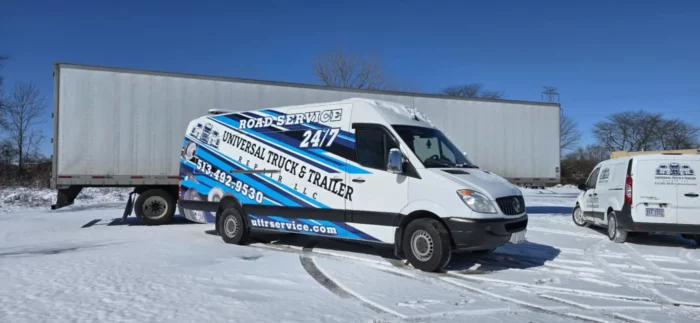
- Call early when something goes wrong on the road. A mobile tech fixing an air line on the shoulder costs less than a tow, and our 24/7 roadside assistance covers Cincinnati and the I-75 and I-275 corridors.
Keep the money where you won’t spend it
- Open a separate account just for maintenance and set up an automatic transfer every settlement.
- Every three months, divide what you spent by the miles you ran. If you’re spending more than you’re putting in, raise the number.
- Raise it again when the warranty runs out and when the truck crosses big mileage marks.
- Build it into your rates. If a load doesn’t cover your maintenance cents per mile along with fuel, the truck payment, insurance and your own pay, it’s costing you money. Once you know your number, cheap freight is easier to turn down.
Planning maintenance with a shop in West Chester Township
Universal Truck & Trailer Repair is a family-owned semi truck repair shop near Cincinnati at 8587 Butler Warren Rd in West Chester Township. Come off I-75 at Union Centre Boulevard (Exit 19) or Tylersville Road (Exit 22) and head east. There’s room on the property for a tractor-trailer to get in and turn around.
Our ASE-certified mechanics work on all makes and models, from day cabs and sleepers to box trucks and trailers. We work on trucks from Cincinnati, West Chester Township, Liberty Township, Fairfield, Mason, Hamilton, Sharonville, Monroe and the rest of the I-75 corridor.
Frequently asked questions
How much should an owner-operator set aside for maintenance per mile?
For a truck out of warranty, 25 to 40 cents a mile, tires included. A newer truck under warranty can start around 15 to 20 cents. Once you have a year of your own invoices, use your actual cost per mile plus a reserve for the big jobs you can see coming.
Does ATRI’s repair and maintenance number include tires?
No. ATRI’s 21.5 cents a mile for 2025 covers parts, labor and roadside service, but not tires or towing. Tires averaged about 5 cents a mile on top of that.
What do owner-operators actually spend on maintenance?
ATBS, which keeps the books for many owner-operators, put its clients’ 2025 maintenance spending at about 14 cents a mile, roughly double what it was a few years earlier. That’s an average across its clients, so an older truck out of warranty will usually cost more.
Do I need a maintenance budget if my truck is still under warranty?
Yes. A warranty covers failures of covered parts. It doesn’t pay for PM, tires, brakes or other wear items, and it runs out. Saving while the truck is new gives you a head start on the years when it isn’t.
Where can I get preventive maintenance on my semi near Cincinnati?
Our shop at 8587 Butler Warren Rd in West Chester Township does preventive maintenance and repairs on all makes, a few minutes off I-75. Call (513) 492-9530 to set up a time that works around your loads.
Want help putting real numbers on your truck?
Call (513) 492-9530 and tell us the year, make and mileage. Bring the truck in for PM and we’ll tell you what’s wearing and roughly when it’ll need work, so you can plan for it. You can also reach us through our contact page.
Universal Truck & Trailer Repair
8587 Butler Warren Rd, West Chester Township, OH 45069
Phone: (513) 492-9530
Email: [email protected]
Shop hours: Monday to Friday 9:00 AM to 5:00 PM, Saturday 9:00 AM to 3:00 PM, closed Sunday
Roadside service: 24 hours a day, 7 days a week
Need truck or trailer repair?
Universal Truck & Trailer Repair keeps owner-operators and fleets moving from our shop in West Chester Township, OH. Call us or request service and we will get you back on the road.