
Cold-Start Failures in Southwest Ohio: What Breaks Every January and How We Fix It
By the crew at Universal Truck & Trailer Repair, 8587 Butler Warren Rd, West Chester Township, OH. ASE-certified diesel and heavy-duty mechanics. We run winter no-start calls across Cincinnati and the I-75 corridor.
Last January was a bad one, and the numbers back that up. According to the National Weather Service office in Wilmington, Ohio, Cincinnati averaged a low of 17.9 degrees for the month, almost 5 degrees under normal. The last week of January never got above freezing. CVG bottomed out at 3 below on the 28th and again on the 31st. Then there was the snowstorm on the 24th and 25th that dropped 10.2 inches on Cincinnati and set a single-day record.
Our phone did not stop.
Here is the thing about cold-start failures: almost none of them are surprises. A truck that will not turn over at 5 degrees on a Tuesday morning was already sick in November. The cold just finished the job. Below is what actually comes through our bays in January, in the order we see it, and what we do about each one.
Batteries, and it is not close
If we had to guess a cause before looking at the truck, we would say batteries and be right most of the time.
The physics are ugly. A lead-acid battery at zero degrees puts out roughly 40 percent of its rated cranking amps. At the same moment, your 15W-40 has thickened up and the engine needs something like twice the torque to turn over. So you have half the power trying to do double the work. A battery bank that cranked fine at 45 degrees in October has no margin left at 5 degrees in January.
The part that trips people up is mixed-age batteries. Most Class 8 trucks run three or four batteries in parallel. A weak one does worse than contribute nothing. It drags the healthy batteries down, because they sit there trying to charge it. We pull a lot of banks where two batteries are two years old and one is six, and the owner has been replacing them one at a time as they die. That is the most expensive way to do it.
What we do: a load test on each battery individually, not a voltage reading. Voltage lies. A battery can sit at 12.6 volts and still collapse under a 300-amp load. We also do a voltage drop test across the cables and ground straps, because corroded grounds fake a bad battery convincingly. If the bank is due, we replace all of them together and match the group and CCA rating.
If you only do one thing before winter, load test the bank in October. It costs almost nothing compared to a tow.
Fuel gelling and filter waxing
Number two on the list, and the one that strands people on the shoulder rather than in the yard.
Number 2 diesel starts dropping wax crystals somewhere around 10 to 20 degrees, depending on the blend and the additive package. The crystals do not stop the truck immediately. They collect in the fuel filter, the filter restricts, and then the engine starves under load. So the classic version is a driver who starts fine at the truck stop, runs 20 minutes, and dies climbing a grade.
The pattern we see most often around here involves fuel bought south of us. A driver fills in Tennessee or Georgia with a summer blend, runs north on I-75, and parks overnight in Ohio at 8 degrees. That fuel was never treated for this. It gels in the tank and in the lines.
Water makes all of it worse. A little condensation in the tank is normal. In January it freezes in the filter housing and in the fuel lines, and now you have an ice plug on top of the wax. If you have been putting off a leaking or corroded tank, cold weather is when it collects the bill. We wrote about what usually goes wrong with semi truck fuel tanks if you want the longer version.
What we do: warm the truck, change the filters, drain the water separator, and treat the tank with an anti-gel that actually has a cold filter plugging point rating on the label. We do not pour in a bottle of whatever and hope. If the fuel is badly gelled we may need to pull and warm the filter housing before anything will flow. On a truck that keeps doing it, we look at whether the tank is picking up water and whether the fuel heater is working.
Grid heaters and intake air heaters
Drivers say glow plugs. Most Class 8 diesels do not have them. Cummins, Detroit, and Paccar engines in this weight class typically use a grid heater, which is a big electrical element in the intake that preheats the air going into the cylinders.
When that element or its relay fails, nothing happens on a 50-degree morning. Nobody notices. Then it drops to 5 degrees and the truck cranks and cranks and will not catch, or it catches and immediately runs rough with white smoke pouring out.
What we do: check the grid heater relay, the element resistance, and whether the ECM is actually commanding it. This is a genuinely common failure and a fairly cheap fix compared to what people assume is wrong when a truck will not start. It is also the one where our computer diagnostics earn their keep, because the fault is often sitting in the ECM as a logged code nobody pulled.
Air system freeze-ups
This one is underrated and it is our second most common roadside call in January after batteries.
Your compressor pushes hot, wet air into the system. The air dryer is supposed to pull that moisture out. When the desiccant cartridge is saturated, which happens on a schedule most fleets ignore, water goes into the tanks. In summer you drain it and forget about it. In January it freezes in valves, in lines, and inside the glad hands.
Symptoms look like a mechanical problem but are not. Brakes that will not release. A trailer that will not charge. Air pressure that builds and then dumps. We have gone out on calls where the entire fix was thawing a frozen glad hand and replacing a torn seal, and the driver had been sitting for three hours convinced the trailer needed a brake job.
What we do: drain every tank, thaw and inspect the valves, replace the air dryer cartridge if it is saturated, and check the purge valve. If you are running alcohol evaporators, we check those too. Annual dryer cartridge replacement is on our preventive maintenance list for a reason, and January is when skipping it shows up.
Frozen DEF and aftertreatment faults
DEF freezes at 12 degrees. That is by design and it does not hurt the fluid. Every truck built since 2010 has heated DEF tanks and heated lines, and the ECM gives the system time to thaw before it starts complaining.
The trouble starts when a heater circuit has failed. Then the fluid stays frozen, the system throws a quality or pressure fault, and the ECM derates you. Sitting on I-75 near Monroe at 40 percent power in a snowstorm is a rough place to learn your DEF tank heater died last spring.
Cold weather also wrecks regens. Short runs and long idle periods in January mean exhaust temperatures never climb high enough for a passive regen. Soot loads up, the truck asks for a parked regen, the driver does not have time, and the loading gets worse until you are looking at a derate or a filter that has to come out and be cleaned.
What we do: pull the codes first, then test the heater circuits and the DEF pump. For the soot side, we check whether the filter is genuinely restricted or whether a sensor is lying about it, then run a parked regen or clean the filter depending on what we find.
Coolant, block heaters, and the extension cord problem
Block heaters fail quietly. The element burns out, or the cord gets crushed and shorts, and the driver plugs in every night thinking he is protected. The first he hears about it is a 5 degree morning with an engine sitting at ambient.
We test block heater elements as part of winter prep, and we check coolant freeze protection with a refractometer rather than a floating-ball tester, which is not accurate enough to trust. Coolant that tests to only 10 degrees of protection is not doing its job in a southwest Ohio January.
Tires, because nobody thinks about this in a no-start article
Cold air contracts. Every 10 degree drop takes roughly one PSI out of a tire. A trailer that sat at 100 PSI in a 60 degree yard in November is running near 90 PSI at 10 degrees, and underinflated tires on cold pavement fail. We pick up a lot of tire work in January that started as a pressure problem in December.
How we actually work a winter no-start
The order matters, because chasing the wrong thing in the cold wastes hours.
We start with the batteries and the grounds, because that is the answer most of the time and it is fast to rule out. Then we pull codes, which tells us whether the grid heater, the DEF system, or a sensor is involved. If the engine cranks well and will not fire, we go to fuel: filter restriction, water in the separator, gelling in the lines. If it fires and dies under load, that is almost always fuel. If the truck starts fine but will not build or hold air, that is the dryer and the valves.
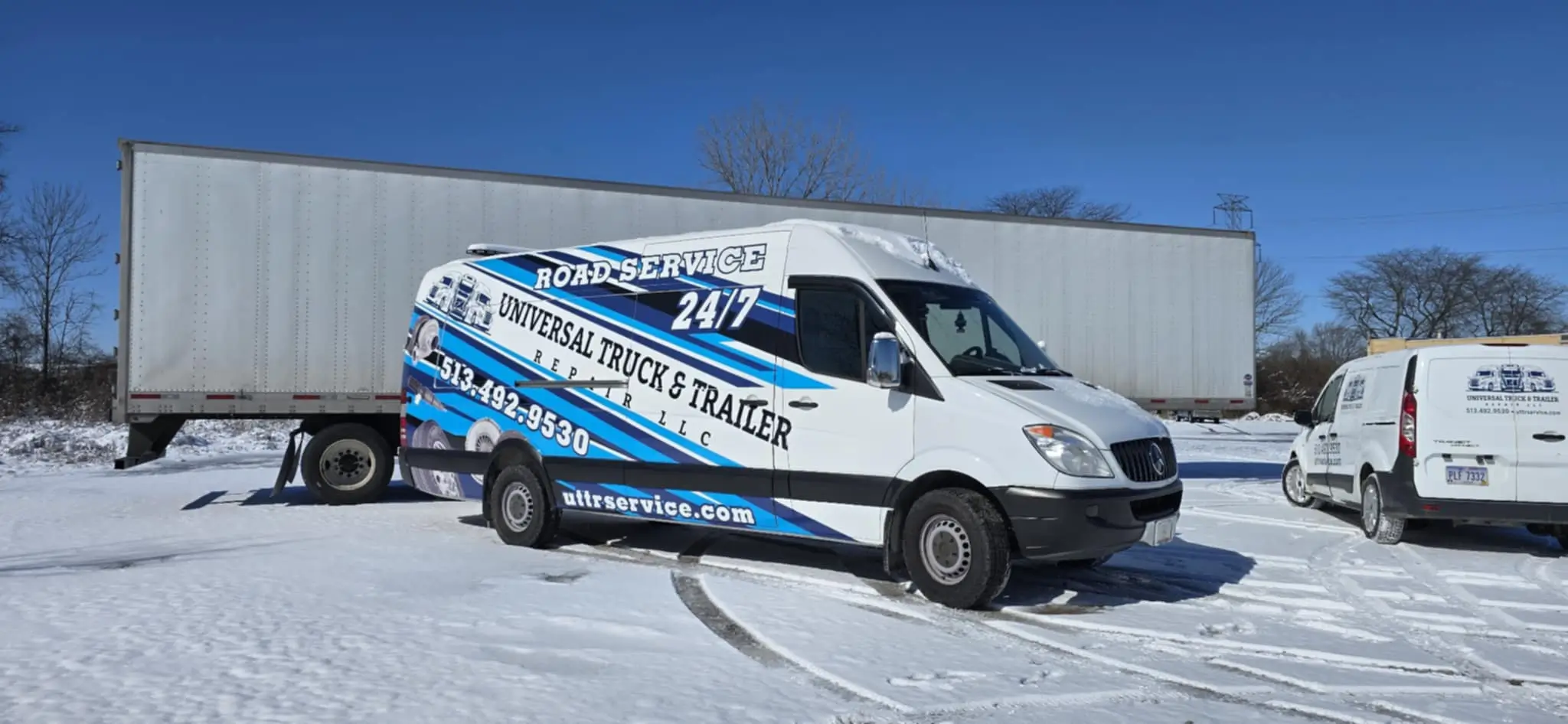
Most winter no-starts we handle at the shop in West Chester Township, which is a couple minutes off I-75 at the Tylersville exit. When the truck cannot move, our 24/7 roadside techs come to you. We run those calls across Cincinnati, Fairfield, Mason, Monroe, Sharonville, Hamilton, Middletown, Springdale, and down into Northern Kentucky.
What to do in October so January is boring
Load test every battery individually and replace the bank as a set if any of them are marginal. Replace the air dryer cartridge. Test the block heater element and the cord. Check coolant protection with a refractometer. Switch to a winter blend or start treating your fuel before the first hard freeze rather than after it. Verify the grid heater works instead of assuming it does. Drain your air tanks weekly once the temperature drops.
None of that is exciting and none of it is expensive. A winter prep inspection runs a fraction of what one tow plus one lost load costs you.
Frequently asked questions
Why will my semi truck not start in cold weather? Most often the batteries. Cold cuts a battery’s usable cranking amps roughly in half while thick oil doubles the torque needed to turn the engine. Other common causes are a failed grid heater or intake air heater, gelled fuel restricting the filter, and a dead block heater element.
At what temperature does diesel fuel gel? Untreated number 2 diesel begins forming wax crystals around 10 to 20 degrees Fahrenheit depending on the blend. The truck usually does not stop right away. The wax collects in the fuel filter and starves the engine under load, which is why gelling often shows up 20 or 30 minutes into a run rather than at startup.
Can you come to me if my truck will not start on I-75? Yes. We run 24/7 mobile service across the Cincinnati area and the I-75 corridor. Call (513) 492-9530 and a person answers.
Why do my truck brakes freeze up? Water in the air system. A saturated air dryer cartridge lets moisture into the tanks, and in freezing weather it locks up valves, lines, and glad hands. Draining the tanks helps. Replacing the dryer cartridge on schedule is the actual fix.
Does DEF freezing damage my truck? No. DEF freezes at 12 degrees and thawing does not harm it. Trucks have heated DEF tanks and lines for exactly this reason. Problems come from a failed heater circuit, which leaves the fluid frozen, throws a fault, and derates the engine.
How much does winter prep cost compared to a breakdown? A prep inspection is a small fraction of one heavy tow plus a missed delivery. Call us for current pricing on your specific truck.
Get your truck looked at before the first hard freeze
Universal Truck & Trailer Repair 8587 Butler Warren Rd, West Chester Township, OH 45069 Phone: (513) 492-9530 Cell: (513) 306-6739
We are a full-service truck and semi truck repair shop serving Cincinnati and West Chester Township, a couple minutes off I-75. All makes and models, day cabs through fleet equipment. Schedule a winter inspection or read more about our shop and our techs.