By the crew at Universal Truck & Trailer Repair, an independent, family-owned truck and trailer shop in West Chester Township, OH. ASE-certified diesel mechanics. Updated November 2026.
A fleet of two to 25 trucks sits in an awkward spot. It’s too big to keep running on “call the shop when something breaks,” and usually too small to pay for full-time mechanics and a shop building of its own. ATRI’s 2026 report on trucking operating costs shows how that plays out: in 2025, fleets with fewer than five trucks did 42% of their maintenance in-house, and fleets with five to 100 trucks did about 55%. The rest went to outside shops.
So for most small fleets, something like half the maintenance happens at someone else’s shop, and how you set up that relationship has a lot to do with how many days your trucks sit. We’re a truck and trailer shop a few minutes off I-75 in West Chester Township, and we do scheduled PM and DOT work for fleets running this corridor.
The short answer
A shop partnership means one shop knows every unit you run. It keeps PM on a schedule that fits how those trucks actually work, does your annual inspections, fixes what drivers write up and answers when a truck breaks down on the road. You agree up front on how repairs get approved, what goes on the invoices and who calls whom. You end up with fewer surprises and a paper trail that holds up when an inspector or auditor asks for it.
Signs your fleet has outgrown “call when it breaks”
- PM due dates live on a whiteboard or in one person’s head, and trucks run past them.
- Each truck has been to a different shop, so its records are spread across three invoices and a glovebox.
- Roadside inspections keep finding things a PM would have caught, like lights, brake adjustment, air leaks and tires.
- The same truck keeps coming back for the same problem.
- Nobody can say offhand when each tractor’s and trailer’s annual inspection runs out.
- Trailers fall behind because they don’t have an engine or an hour meter to remind anyone.
What the federal rules expect you to keep
FMCSA’s maintenance rules are in 49 CFR Part 396. Every motor carrier has to systematically inspect, repair and maintain the vehicles it controls. For a small fleet, three sections turn into most of the paperwork.
Records come first. Section 396.3 says you keep them for every vehicle you control for 30 days in a row or more. Each record has to identify the vehicle (your unit number if it’s marked, plus make, serial number and year, and the owner’s name if it isn’t yours), show what inspections and maintenance are due and when, and log each inspection, repair and maintenance job with its date and what was done.
Driver write-ups are covered in § 396.11. Drivers prepare a vehicle inspection report at the end of each day’s work for each vehicle they drove, though they don’t have to file one if they found no defects and none were reported to them. When a report does list a safety defect, it has to be fixed before the truck goes back out, and you (or your shop, acting as your agent) certify the repair on the report. Carriers that operate only one truck are exempt from this section.
Then there’s the annual inspection in § 396.17. Every commercial vehicle has to pass an inspection covering the items in Appendix A to Part 396 at least once every 12 months, with proof of it on the vehicle, either the report or a decal. Each trailer needs its own inspection, separate from the tractor’s. You can do the inspections yourself, or have a commercial garage do them as your agent as long as it has qualified inspectors under § 396.19.
| Record | Rule | How long to keep it |
|---|---|---|
| Maintenance records for each vehicle | § 396.3 | 1 year where the vehicle is housed or maintained, and 6 months after it leaves your control |
| Driver vehicle inspection reports, repair certifications and the driver’s review | § 396.11 | 3 months |
| Annual inspection report | § 396.21 | 14 months, where the vehicle is housed or maintained |
| Proof of your annual inspector’s qualifications | § 396.19 | While they inspect for you, plus 1 year |
A good shop hands you most of this on its invoices and inspection reports, but keeping it organized and on file is still your job as the carrier. This is a summary, so read the rules themselves or check with your safety consultant about your own operation.
Who does what in a good setup
| Job | The shop | Your fleet |
|---|---|---|
| PM | Works to a schedule for each unit and tells you what’s coming due | Gets the trucks in on time |
| Annual inspections | Does them with a qualified inspector and gives you the report | Keeps the report 14 months and makes sure proof is on the truck |
| Driver write-ups | Fixes the defects and notes the repair on the invoice | Drivers write up defects, and the repair gets certified before the truck rolls |
| Records | Puts unit number, VIN, mileage, parts and labor on every invoice | Files them by unit, in one place |
| Breakdowns | Answers the roadside call | Drivers call with the unit number, location and what happened |
| Warranty and recalls | Tells you when a job belongs at the dealer | Books the dealer |
| Approvals | Calls before going past the limit you set | Sets the limit and picks up the phone |
Setting it up, step by step
1. Send the shop your unit list
For each tractor and trailer, list the unit number, VIN, year, make, model, engine, current mileage or hours, last PM date and annual inspection date. If you run refrigerated trailers, list the reefer units separately, since they have their own service schedule.
2. Set PM intervals by how each truck runs
Most engine makers’ maintenance manuals set service intervals by duty cycle, and short-haul work with lots of stop-and-go and idling usually falls on the shorter schedule. A truck doing regional loads around the I-75 warehouses doesn’t wear the same way as one running to Columbus and back. If your trucks run the same corridor every day, ask for a route-specific PM. We set those up for our local fleet customers, because we see what I-75 does to trucks every week.
3. Agree on how repairs get approved
Pick a dollar amount: below it the shop goes ahead, and above it someone calls you first. Decide who at your company can say yes, and what happens when a truck comes in after hours or on a weekend.
4. Agree on what goes on the invoice
Ask for the unit number, VIN, mileage, what was found, what was done and the part numbers. That’s the repair and maintenance log § 396.3 asks you to keep, so filing it means dropping the invoice in the right unit’s folder.
5. Give your drivers a breakdown plan
Put the shop’s number in every cab. Tell drivers what to have ready when they call: unit number, direction and mile marker, what the truck is doing and whether it’s loaded. Our post on breaking down near the Monroe scales has a good list of what to tell the shop when you call.
6. Review it every quarter
Look at what each unit cost to maintain, which trucks came back for the same repair, and which annual inspections are coming due. A truck whose repair bills keep climbing quarter after quarter is the one to start planning a replacement for.
Scheduling PM without losing loads
- Do the PM and the annual inspection in the same visit so the truck is down once.
- Bring the tractor and trailer in together. A truck and trailer shop can handle trailer repair in the same visit, which saves a second day out of service.
- Use Saturdays. We’re open 9 to 3 on Saturdays, which helps fleets that run hard all week.
- Stagger your units so only one or two trucks are down on any given day.
- Plan around the seasons. Fall is the time for batteries, air dryers and fuel, before the January cold-start failures show up. Spring is for brakes, wiring and air lines after a winter of road salt.
Questions to ask before you send a shop your fleet
- Do you work on every make we run, tractors and trailers both?
- Do you do annual DOT inspections, and can you give us proof of your inspector’s qualifications for our files?
- How will you keep track of PM due dates for each of our units?
- What goes on your invoices?
- How do approvals work, and will you call before going over our limit?
- How soon can you get a down truck into a bay?
- Do you run 24/7 roadside service, and what area do you cover?
- If a truck is under warranty or has an open recall, will you tell us to take it to the dealer? (Here’s how we think about dealer versus independent shops.)
Running a small fleet around Greater Cincinnati
Most small fleets here run some mix of I-75, I-71 and I-275, with a lot of regional work in and out of the warehouses in West Chester, Union Centre, Fairfield and Monroe and the logistics parks across the river in Northern Kentucky. That kind of stop-and-go work goes through brakes and clutches faster than long highway runs, which is one more reason to set PM by duty cycle instead of a single mileage number.
The weather adds its own costs. Winter brings cold starts and a lot of road salt, and the freeze-thaw cycle leaves potholes that knock alignments out. If your trucks cross the I-75 scales at Monroe, our guide to what inspectors check near the Monroe scales covers what gets trucks placed out of service.
Working with us in West Chester Township
Universal Truck & Trailer Repair is a family-owned truck and trailer repair shop in West Chester Township at 8587 Butler Warren Rd. Come off I-75 at Union Centre Boulevard (Exit 19) or Tylersville Road (Exit 22) and head east. There’s room on the property for a tractor-trailer to get in and turn around, which matters when you’re dropping off a full unit.
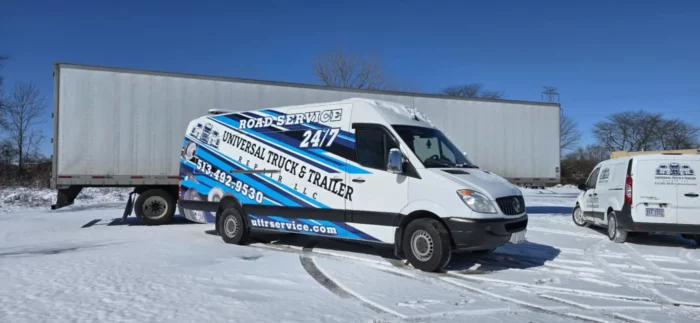
Our ASE-certified mechanics work on all makes and models, tractors and trailers. We do scheduled preventive maintenance, DOT inspections, diagnostics, and engine, electrical and aftertreatment work, and we run paint, body and mechanical departments. The full service list has the rest. Our 24/7 roadside assistance covers Cincinnati, West Chester Township, Mason, Monroe, Sharonville, Springdale, Fairfield, Hamilton and the I-75 and I-275 corridors in between.
Most of our work comes from referrals: other drivers, other shops and fleet managers who got tired of guessing. You talk to the people who worked on your trucks, and you get a straight answer on what needs fixing now and what can wait.
Frequently asked questions
How often should small fleet trucks get PM?
Go by your engine manufacturer’s maintenance manual. Most set intervals by duty cycle, and short-haul, stop-and-go work with a lot of idling usually calls for the shorter schedule. Trailers need their own schedule for brakes, lights, tires and air lines, since they don’t log engine hours.
What maintenance records does FMCSA require a fleet to keep?
For each vehicle you control for 30 days in a row or more, § 396.3 requires an identification of the vehicle, a way to show what inspections and maintenance are due and when, and a record of each inspection, repair and maintenance job with its date. Keep those records for a year where the vehicle is housed or maintained, and for six months after the vehicle leaves your control.
How long do we have to keep annual inspection reports?
Fourteen months from the date of the inspection, kept where the vehicle is housed or maintained, under § 396.21. Proof of the inspection also has to be on the vehicle, either the report or a decal.
Do drivers have to fill out a vehicle inspection report every day?
A driver has to prepare one at the end of the day’s work for each vehicle they drove, but the rule doesn’t require one if no defect was found or reported. Some fleets have drivers fill one out every day anyway so nothing slips through. Keep the reports and the repair certifications for three months.
Can a repair shop do our annual DOT inspections?
Yes. Under § 396.17, a carrier can have a commercial garage do the annual inspection as its agent, as long as the garage has the right facilities and uses qualified inspectors. We do DOT inspections at our West Chester Township shop.
Do you work with small fleets near Cincinnati?
Yes. We work on fleet trucks and trailers from Cincinnati, West Chester Township, Liberty Township, Fairfield, Mason, Hamilton, Sharonville, Monroe and the rest of the I-75 corridor. Call (513) 492-9530 to talk about your units.
Talk to us about your fleet
Call (513) 492-9530 and tell us how many units you run, what makes they are and what kind of work they do. We’ll talk through how PM, inspections and roadside calls would work for your trucks. You can also reach us through our contact page.
Universal Truck & Trailer Repair
8587 Butler Warren Rd, West Chester Township, OH 45069
Phone: (513) 492-9530
Email: [email protected]
Shop hours: Monday to Friday 9:00 AM to 5:00 PM, Saturday 9:00 AM to 3:00 PM, closed Sunday
Roadside service: 24 hours a day, 7 days a week
Need truck or trailer repair?
Universal Truck & Trailer Repair keeps owner-operators and fleets moving from our shop in West Chester Township, OH. Call us or request service and we will get you back on the road.